
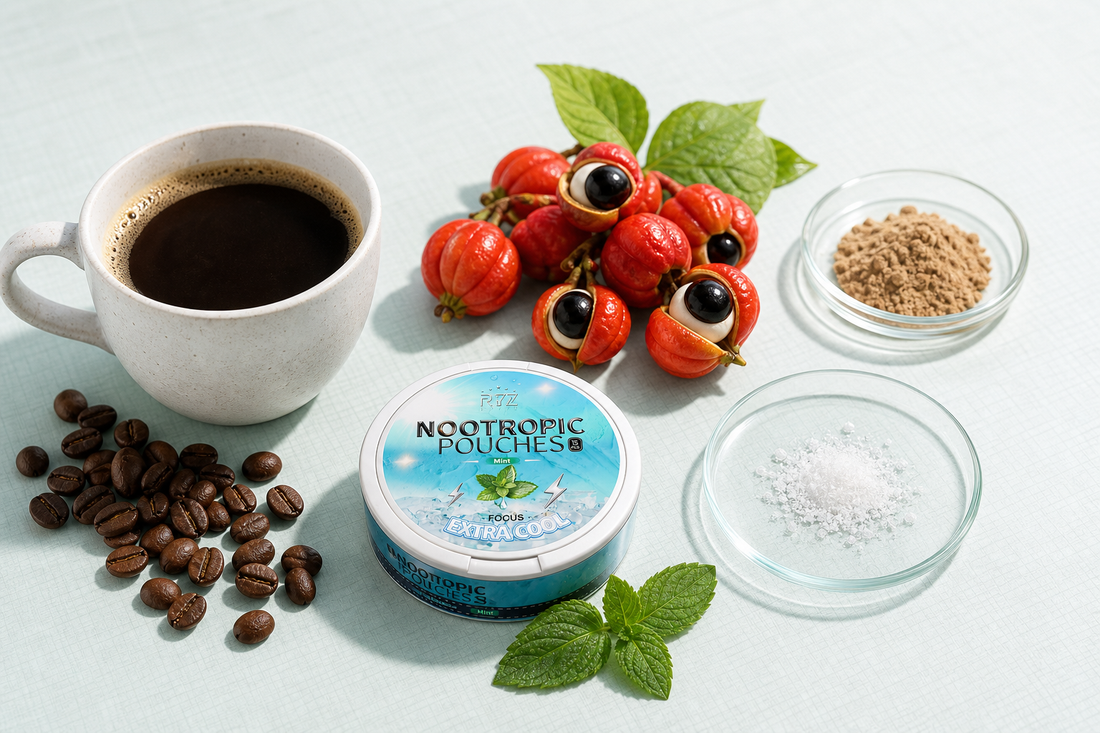
That answer is less dramatic than most “natural versus synthetic” marketing. It is also more useful.
If you want to compare caffeine sources, start with the milligrams of caffeine in the serving. Then look at the rest of the product: the plant material or other ingredients, the delivery format, the label, and how all of those details fit your routine.
Start with the molecule: caffeine is caffeine
Caffeine is the compound 1,3,7-trimethylxanthine. PubChem lists guaranine as another name for caffeine, not a separate stimulant hiding inside guarana.
Coffee plants and guarana plants make caffeine naturally. Synthetic caffeine is manufactured instead of extracted from a plant. Once you are comparing the caffeine itself, however, the source does not create a new caffeine molecule.
The FDA makes the practical point directly: it says there is no difference in how the body handles, or in the safety of, caffeine that occurs naturally in coffee and tea and caffeine that is added to a product. Caffeine from every source still counts toward the same daily total.
What actually changes between coffee, guarana, and synthetic caffeine?
| Question | Coffee | Guarana | Synthetic caffeine |
|---|---|---|---|
| Where does the caffeine come from? | Coffee beans | Seeds of the Paullinia cupana plant | A manufacturing process |
| What commonly comes with it? | A brewed beverage with flavor, acids, and other coffee compounds | Plant material or an extract whose other constituents depend on processing | Purified caffeine itself does not bring the original plant matrix; the finished product may contain other ingredients |
| How easy is the dose to predict? | It can vary with bean, brew, serving size, and product | It depends on whether the material is seed, powder, or a standardized extract and whether final caffeine is disclosed | A finished product can state a direct caffeine amount, but the label still has to be checked |
| Does the source prove a different caffeine effect? | No | No | No |
| What should you compare first? | Caffeine per actual serving | Final caffeine per serving, not only milligrams of guarana | Caffeine per serving and the complete finished-product formula |
The biggest mistake is comparing raw ingredients instead of finished servings. A guarana seed can contain a higher percentage of caffeine than a coffee bean, but that does not tell you whether one guarana product contains more caffeine than a particular cup of coffee. The serving size and final milligrams decide the caffeine-quantity comparison.

Coffee gives you more than an isolated caffeine dose
A cup of coffee is a beverage, not purified caffeine in water. It also contains compounds from the bean and brewing process, including chlorogenic acids and trigonelline, as well as the flavor and aroma that make coffee a ritual for many people.
Its caffeine amount is not fixed. The FDA lists a wide range for a 12-ounce brewed coffee and advises consumers to check specific product information when possible. Bean variety, brewing method, serving size, and the product you order can all change the amount.
That variability is not automatically a problem. Coffee may be exactly the right choice when you want the taste, warmth, break, or social routine. It simply means “one cup” is not a precise caffeine unit.
For the format decision rather than the source question, read our caffeine pouches vs. coffee comparison.
Guarana is a botanical source—but the extract still needs a number
Guarana is an Amazonian plant whose seeds naturally contain caffeine. Guarana ingredients can appear as seed, powder, or extracts with different caffeine concentrations.
That is why a label saying only “made with guarana” is incomplete for consumer dose comparison. A useful label should tell you the final caffeine amount per serving. If it also states the extract amount and standardization percentage, you can check whether the numbers make sense together.
Kryze uses 228mg of a guarana extract standardized to at least 22% caffeine and labels the result clearly as 50mg caffeine per pouch. Our guarana caffeine content guide explains that calculation and separates the plant source, extract manufacturing location, raw-material report, and finished-product claims.
Synthetic caffeine changes the source, not the identity
Synthetic caffeine is produced through manufacturing rather than harvested from a caffeine-containing plant. In a finished food or supplement, it is commonly used as a purified ingredient with a stated amount.
That can make dosing straightforward, but it does not make every synthetic-caffeine product equally transparent or well formulated. You still need to check the serving size, total caffeine, other active ingredients, directions, and warnings.
The term caffeine anhydrous describes a form of caffeine that is essentially without water. It does not, by itself, promise faster action, greater strength, better quality, or a particular subjective experience. If the ingredient’s origin matters to you, look for a sourcing statement or ask the manufacturer instead of guessing from the word “anhydrous.”
Does guarana caffeine release more slowly or last longer?
Guarana is often marketed as smoother, slower-releasing, or longer-lasting. The limited studies reviewed here do not establish those outcomes as a general fact about guarana caffeine.
An early study comparing guarana capsules with an equivalent amount of free caffeine found no significant difference in laboratory dissolution. It also found no significant uptake difference in an isolated rat-intestine model. Those are limited methods, not a finished-product human trial, but they do not support a blanket “natural slow release” promise.
A small randomized crossover trial enrolled 16 healthy men, with 15 completing both study periods, and compared 60mg of caffeine from green coffee extract with 60mg of synthetic caffeine. The caffeine peak concentration and four-hour exposure were statistically equivalent. The study does not test guarana or Kryze and does not prove that every product will feel identical, but it is another reason not to turn “natural” into a guaranteed pharmacokinetic advantage.
A deliberately designed extended-release formulation may behave differently. That difference would come from the formulation and supporting evidence, not automatically from the plant named on the front of the package.
Why can the same milligrams still feel different?
People can have different experiences without the caffeine molecule changing. Before crediting the source, consider:
- whether the servings really contained the same caffeine dose;
- whether one was consumed quickly and another gradually;
- whether it came as coffee, a capsule, gum, a drink, or another format;
- what food, sugar, flavors, or other active ingredients came with it;
- recent sleep, food intake, caffeine tolerance, medications, and health conditions;
- individual differences in caffeine sensitivity and metabolism;
- expectations created by the product and the situation.
Personal experience can help someone choose a preferred format. It cannot establish that all guarana, coffee, or synthetic caffeine products produce that same experience for everyone.
Is natural caffeine healthier than synthetic caffeine?
“Natural” describes origin. It does not establish a universal safety or health advantage.
Coffee and botanical extracts may contain other plant compounds, but their presence does not automatically make the caffeine safer. A plant-derived product can still deliver a high or poorly disclosed caffeine dose. A synthetic-caffeine product can be precisely labeled, or it can be difficult to evaluate if the serving information is unclear.
The better safety questions are practical:
- How much caffeine is in one serving?
- How many servings are you using?
- What other sources of caffeine have you had that day?
- What else is in the product?
- Do the directions, warnings, and evidence match the claims?
How to compare caffeine labels without the marketing fog

Use this order:
- Find caffeine per serving. Do not substitute a plant-extract amount for the final caffeine amount.
- Check the serving unit. One pouch, capsule, scoop, can, or cup can represent very different quantities.
- Add every caffeine source. Coffee, tea, guarana, energy products, medications, and other sources all contribute.
- Separate source from dose. Source can matter for traceability and accompanying ingredients, but it does not replace milligrams.
- Read the complete formula. The finished product, not caffeine alone, is what you use.
- Look for evidence matched to the claim. A supplier specification, raw-material test, finished-product test, and clinical trial answer different questions.
- Ignore unsupported shortcuts. “Natural,” “clean,” “smooth,” and “no crash” are not substitutes for evidence.
Our caffeine pouch ingredient guide shows how to apply this label-first method to a complete pouch formula.
Choose a guide based on what you need to compare: use the guarana content calculation for extract milligrams and concentration, or the energy drink comparison for labeled servings, sugar and format. Those questions require different evidence from a comparison of caffeine sources.
Where Kryze fits
Kryze uses caffeine from a documented, standardized guarana source. Each pouch contains:
- 50mg caffeine from 228mg guarana extract;
- 40mg Alpha-GPC;
- 40mg L-Tyrosine;
- 40mg L-Theanine;
- 20mg CoQ10.
The guarana is sourced in Brazil. Nexira manufactures and standardizes the extract in France. That traceability explains where the caffeine comes from; it does not turn the caffeine into a different molecule or prove a slower, smoother, safer, or longer-lasting effect.
Kryze is also sugar-free, nicotine-free, and tobacco-free, with 15 pouches per can. The practical differences are the labeled 50mg serving, disclosed formula, and pouch format—no drink or mixing required.
If that combination fits what you want, compare the current flavors and pack options in the Kryze caffeine pouch collection. If you prefer a caffeine-free product, a serving below 50mg, or a coffee ritual, Kryze is not the right answer to this particular decision.
The bottom line
Coffee, guarana, and synthetic processes can all provide caffeine. At the molecular level, caffeine is caffeine.
Source still matters when you care about the beverage, plant material, accompanying ingredients, traceability, formulation, or production story. But source is not a shortcut to “better.” For an honest comparison, use the final caffeine amount, the complete product, and your own situation.
Frequently asked questions
Is guaranine different from caffeine?
No. Guaranine is another name for caffeine. PubChem lists both names for the same compound.
Does guarana have more caffeine than coffee?
Guarana seed can contain a higher caffeine percentage than coffee beans, but that does not tell you the dose in a finished serving. Compare the labeled caffeine milligrams in the actual guarana product with the caffeine in the actual coffee.
Is synthetic caffeine bad for you?
Source alone does not make a caffeine product safe or unsafe. The FDA says the body handles naturally occurring and added caffeine the same way. Total dose, individual sensitivity, other ingredients, directions, and product quality matter more.
Does guarana caffeine last longer than coffee or synthetic caffeine?
The limited studies cited here do not establish that as a general rule. Products and formats can differ, but the evidence reviewed for this article does not support promising that guarana itself creates slower release or longer-lasting effects.
Is caffeine anhydrous always synthetic?
“Anhydrous” describes the form of the caffeine, not a guaranteed source claim. Check the manufacturer’s sourcing information if you need to know whether the caffeine was plant-derived or synthetically produced.
Should caffeine from guarana count toward my daily total?
Yes. Count the final caffeine amount from guarana alongside coffee, tea, energy products, medications, and every other source.
Sources
- FDA: Spilling the Beans — How Much Caffeine Is Too Much?
- PubChem: Caffeine, CID 2519
- Bempong and Houghton: Dissolution and absorption of caffeine from guarana
- Morton et al.: Green coffee bean extract compared with synthetic caffeine
- Nexira: Guarana supplier sourcing and manufacturing information
- FTC: Health Products Compliance Guidance


