
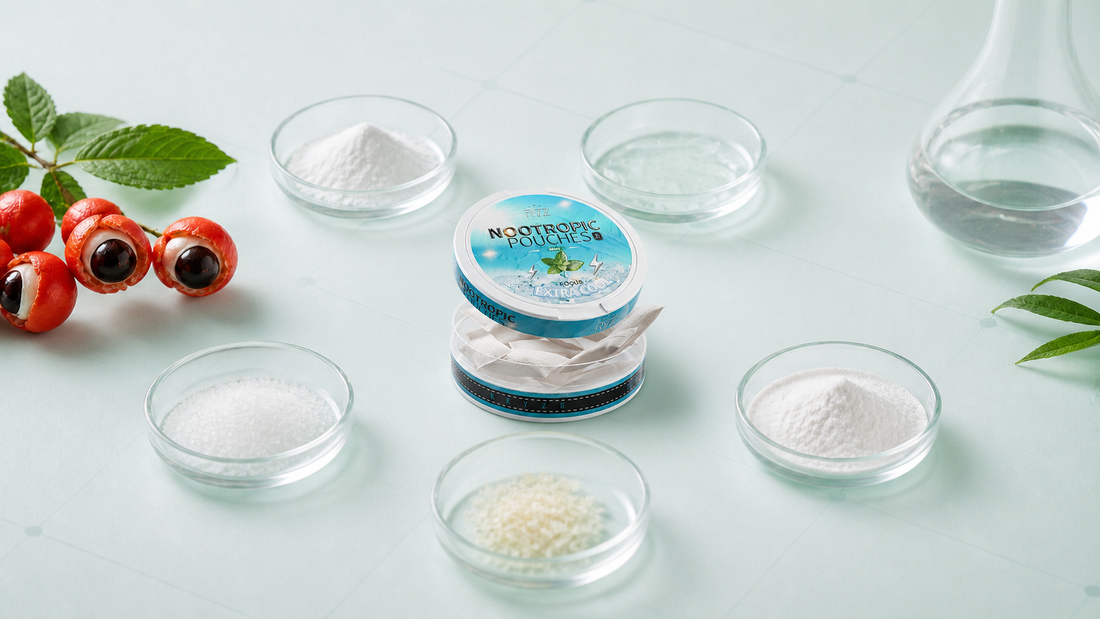
“Nootropic pouch” is a name used for oral pouches containing ingredients marketed for mental performance. The term itself does not establish a clinical result. “Does it work?” can mean feeling more awake, performing better on a cognitive task, or enjoying a convenient oral pouch. Those are different outcomes. A strong mint sensation or a pleasant routine does not measure cognitive improvement.
Product facts and cited research checked October 1, 2026. This is a guide from Kryze about its own product, not an independent product review or a systematic evidence review.
Do nootropic pouches actually work?
If you mean feeling more awake
Caffeine stimulates the central nervous system and can increase wakefulness. How noticeable that feels varies. That general caffeine effect does not prove a particular pouch produces the same experience for every person. MedlinePlus explains caffeine and its effects.
If you mean better memory, focus, or work performance
Ask for more than an ingredient list. A study of one ingredient, a higher dose, or a swallowed supplement cannot automatically establish the effect of a lower-dose, multi-ingredient pouch. A result on one laboratory task also does not establish an improvement in an entire workday.
If you mean the pouch format feels useful
Convenience is a separate reason to buy. An adult may prefer not carrying a drink during a commute or while working with their hands. Someone who wants the taste and ritual of coffee, or the lowest cost for caffeine, may prefer another format. If you want only an oral habit without stimulants, a caffeinated pouch does not meet that need.
What is in one Kryze pouch?
| Ingredient | Labeled amount per pouch |
|---|---|
| Caffeine | 50mg, supplied by 228mg of guarana extract |
| L-Theanine | 40mg |
| Alpha-GPC | 40mg |
| L-Tyrosine | 40mg |
| CoQ10 | 20mg |
The 50mg caffeine is included in the 228mg guarana amount; these are not two separate caffeine doses. Fresh Mint, Citrus Mint, and Green Apple Mint have the same active amounts. Read the complete ingredient guide for flavor-specific ingredients and the scope of the supplier documents.
How do those amounts compare with research?
Caffeine and L-Theanine: 50mg + 40mg in Kryze
A 2008 crossover trial in 27 healthy volunteers tested 50mg caffeine with 100mg L-theanine, caffeine alone, and placebo. The combination improved some attention-task measures at particular time points. Kryze contains 40mg L-theanine, and the study did not test this pouch. Matching the caffeine amount alone does not reproduce the tested combination or establish an added benefit from Kryze’s 40mg L-theanine. Owen and colleagues, 2008.
Alpha-GPC: 40mg in Kryze
A 2024 crossover trial in 20 resistance-trained men tested 315mg and 630mg of a branded Alpha-GPC ingredient. Results differed by task: some Stroop measures improved, while N-back and Flanker results did not show significant improvements. The study was industry-funded. These results do not establish that 40mg in a pouch improves memory or focus. Read the 2024 Alpha-GPC trial.
L-Tyrosine: 40mg in Kryze
A randomized trial published online in 2019 used 2,000mg L-tyrosine in 70 healthy volunteers. Under the more demanding task condition, it found worse rather than better cognitive flexibility. This is one example of why “studied for cognition” does not mean a benefit in every setting. It neither demonstrates benefit nor predicts the effect of Kryze’s 40mg dose. Robson and colleagues, 2020 issue.
CoQ10: 20mg in Kryze
A 2020 placebo-controlled trial in 62 adults with persistent mild fatigue studied 100mg or 150mg daily of ubiquinol, a form of CoQ10, for 12 weeks. It reported improvements in certain fatigue-related ratings and disclosed industry funding. That different form, dose, and repeated-use schedule do not establish an immediate cognitive benefit from a 20mg CoQ10 pouch. Mizuno and colleagues, 2020.
These studies are not a complete review of each ingredient. They also do not identify a minimum effective pouch dose. The appropriate conclusion is that the results cannot be transferred directly to the finished Kryze formula.
What evidence would support a claim about the finished pouch?
A relevant study would test the actual product and delivery method, at its intended serving, in the population named in the claim. It would measure a defined outcome against an appropriate control. A caffeine-only comparison would help separate the contribution of caffeine from any additional benefit of the blend.
Kryze has not published a controlled clinical trial demonstrating cognitive improvement from its finished pouch. Disclosed amounts help you evaluate the formula; they are not a substitute for that evidence.
Likewise, the available guarana raw-material report relates to the documented ingredient lot. It is not a current finished-product batch test, an absorption study, or proof of cognitive benefit. See what our ingredient documents do and do not establish.
Why might one person notice something and another not?
People may be judging different things: stimulation, mouthfeel, flavor, or whether they finished a task. Regular caffeine use and individual sensitivity can also affect the experience. A personal impression cannot identify which ingredient caused it. MedlinePlus discusses sensitivity and tolerance.
Neither a subtle feeling nor fading flavor tells you how much caffeine remains in your body. Do not add pouches in pursuit of a stronger sensation. Count all caffeine sources using the 50mg and daily-total guide.
Is a nootropic pouch worth buying?
First decide which product feature you value. Kryze offers a labeled 50mg caffeine serving, a compact format, and three flavors. Those are checkable features. A promise of effortless concentration, better memory, or an irritation-free experience would require different evidence.
If the format suits you, one can contains 15 pouches for $5.99 before shipping and tax. The $34.99 seven-can pack has 105 pouches of one flavor. A smaller first order can reduce commitment to an unfamiliar taste; it does not guarantee a refund if you dislike it. The delivered-cost guide explains those trade-offs.
Kryze is for adults and is not intended for children, pregnancy, nursing, or caffeine sensitivity. Check with a qualified healthcare professional if you take medication or manage a health condition. See the first-use guide and mouth-comfort and side-effects guide before deciding.
Questions to ask of any nootropic pouch
- Is every active amount disclosed? A blend total cannot tell you the individual doses.
- What was actually studied? Check the ingredient form, dose, delivery method, duration, participants, and outcome.
- Was the finished product tested? Supplier paperwork and customer testimonials answer different questions.
- What will the order cost? Include quantity, shipping, tax, and any recurring-payment terms.
For a broader checklist, read how to choose caffeine pouches. For the current product options, see Kryze flavors and pack sizes.
Source check
The linked studies describe their own interventions, not Kryze. A 2024 paper comparing caffeine delivery formats was retracted; it is excluded from this guide’s evidence and is not used to support rapid-absorption claims. Retraction record.


