
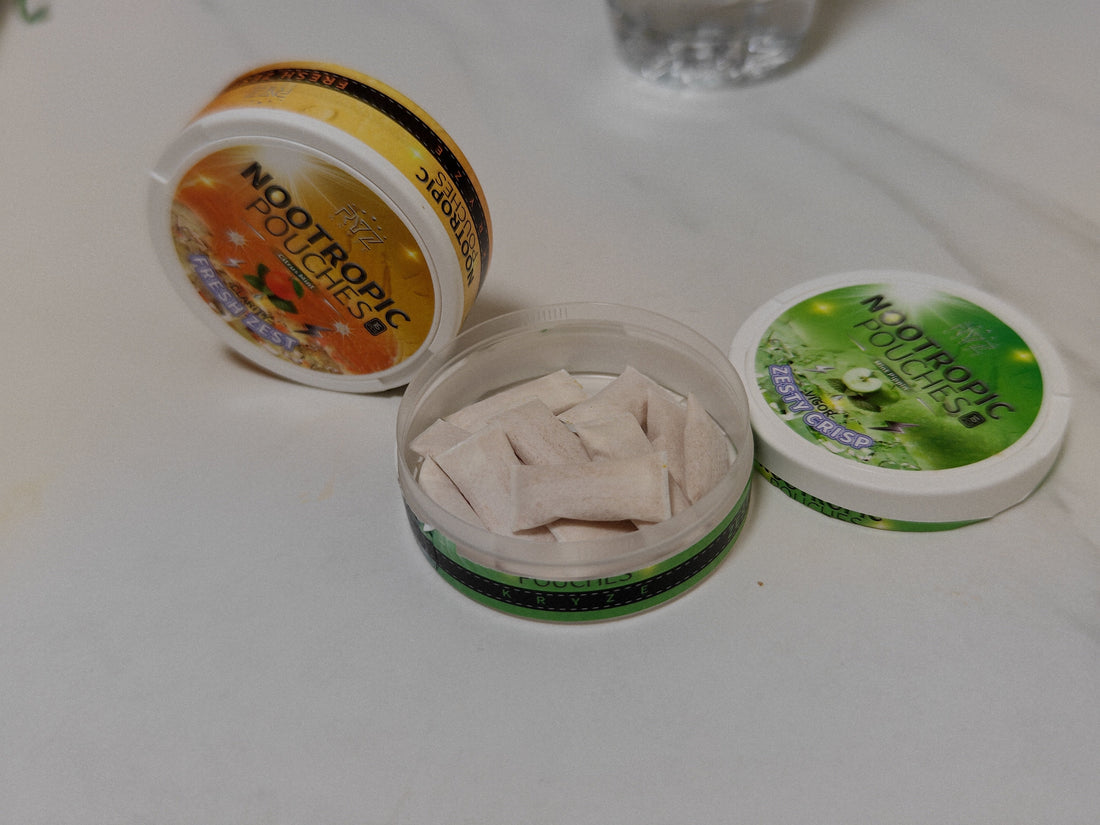
If you already know you want caffeine without a cup of coffee, the useful question is what you want to carry and use. Do you want something flavored that stays in your mouth, something to chew, or a tablet? This comparison looks at those trade-offs without assuming the most expensive format works best.
U.S. product pages and prices checked October 1, 2026. Kryze publishes this guide and sells the pouch included below. The other products are examples, not a survey of every brand or a clinical comparison.
Start with the format
| Format | How it is used | The practical trade-off |
|---|---|---|
| Caffeine pouch | An intact pouch rests in the mouth, then is removed and discarded. It is not chewed or swallowed. | No drink or chewing, but you need to be comfortable with a pouch in your mouth and dispose of it afterward. |
| Caffeine tablet or capsule | Swallowed according to its label, typically with water. Check the particular product's directions. | No lingering flavor or pouch to hold in the mouth. The dose per unit may be much higher than the pouch or gum you are comparing. |
| Caffeine gum | Chewed according to its directions; the gum is discarded afterward. | Fits a preference for chewing and flavor. Chewing may be less convenient in some work or social situations. |
All three are portable. The difference is what you do with them, not simply whether they fit in a pocket. Someone who enjoys coffee's warmth, taste, or a café break may still prefer coffee over any of these options.
Compare actual labeled amounts and prices
These are listed item prices before shipping, tax, discounts, or subscriptions. The per-unit figure is the pack price divided by its piece count, rounded to the nearest cent.
| Example | Caffeine per unit | Pack and item price | Approx. cost per unit |
|---|---|---|---|
| Kryze — single can | 50mg per pouch | 15 pouches · $5.99 | $0.40 |
| Kryze — 7-Pack | 50mg per pouch | 105 pouches, one flavor · $34.99 | $0.33 |
| Prolab Caffeine — 100 tablets | 200mg per tablet | 100 tablets · $9.98 | $0.10 |
| Neuro Energy & Focus Gum — Peppermint | 40mg per piece | 54 pieces · $24.99 | $0.46 |
Sources: Kryze pack options, Prolab's 100-tablet product, and Neuro's Peppermint 54-piece product. Prices and formulations can change; check the exact variant before buying.
In these examples, the tablet has the lowest item cost per unit. If cost is your main priority and its directions and dose suit you, there is no reason to pretend a pouch is always the better purchase. A pouch's extra cost buys a particular format, flavor, and formula; price alone does not establish a better result.
Include the cost of trying the product
The cheapest unit price can require a larger first purchase. One Kryze can is a $5.99 item commitment; a seven-pack is $34.99 and contains only one flavor. Shipping can change the comparison, especially for a small order.
Calculate delivered cost per unit = (item subtotal − discount + shipping + tax) ÷ units ordered. Use the actual checkout values for each seller. Then consider how much of that flavor or format you are ready to buy, as well as the return and subscription terms.
Kryze's current policy does not cover a return just because you dislike the taste. Read the return policy and pack-cost guide before treating a larger pack as a saving you will definitely use.
Which format fits your routine?
- You want caffeine without a drink or chewing: a pouch may fit, provided you are comfortable with how it feels in your mouth. Read the first-use instructions.
- You already like chewing gum: caffeine gum may be the more familiar format. Check caffeine per piece rather than treating it like ordinary non-caffeinated gum.
- You want no prolonged flavor or oral contact: a tablet may suit that preference, but verify its dose and swallowing directions first.
- You want the oral routine without adding caffeine: choose a genuinely caffeine-free option. None of the three caffeinated examples above meets that goal.
A compact product is not a substitute for sleep. If caffeine disrupts your sleep or makes you feel unwell, switching from a drink to a pouch, tablet, or gum does not remove the caffeine itself.
Does one work faster or feel better?
This comparison does not rank absorption speed. That requires suitable research on the actual formulation and delivery method, not just the word “oral” on a product page. Kryze has not published a head-to-head study showing its pouch works faster than these tablets or gum.
Ingredients and dose also differ. Kryze lists 50mg caffeine plus 40mg each of L-Theanine, Alpha-GPC, and L-Tyrosine, and 20mg CoQ10. Neuro's selected gum lists 40mg caffeine and 60mg L-theanine, alongside vitamins B6 and B12. Those labels tell you the amounts; they do not establish which finished product improves your concentration. Read how to evaluate ingredient research.
Count caffeine across all formats
The FDA cites 400mg a day as an amount not generally associated with negative effects for most adults. It is not a target, a per-sitting dose, or a guarantee for an individual. Sensitivity, medication, and health conditions matter, and caffeine from coffee, gum, tablets, pouches, and pre-workout all counts. FDA caffeine guidance.
Kryze is intended for adults and is not intended for children, pregnancy, nursing, or caffeine sensitivity. Ask a qualified healthcare professional about medication or a health condition. Nicotine-free does not mean caffeine-free, and a flavored pouch is not guaranteed to be comfortable for every mouth.
If a pouch causes burning or pain, remove it and stop use. For more on mouth discomfort and systemic caffeine reactions, see the side-effects guide. For counting drinks already consumed, use the 50mg guide.
A useful next step
Choose the dose and format you actually want before comparing pack sizes. If you are interested in Kryze, the flavor guide explains the three flavor directions and links directly to single cans and seven-packs. If you mainly want the lowest item cost or enjoy chewing gum, the alternatives above deserve a fair look too.


